Friday, November 13, 2009

Dinner with Dallaire

One of the benefits of being in policy school is the opportunity to attend intimate dinners with luminaries, to be able to ask them questions in a small forum and exchange ideas. On Monday, I was able to join a small dinner with General Romeo Dallaire, the former head of the UN Assistance Mission in Rwanda (UNAMIR) during the 1994 genocide. General Dallaire, in 1994, was informed that a genocide was imminent, and informed Kofi Annan at the United Nations that action could and should be taken to prevent it from happening.

This warning fell on deaf ears. Once the genocide started, ten Belgian peacekeepers were killed, and the United Nations, for this reason as well as member nation reticence to become involved, reduced its troop levels there to a skeleton force. With few peacekeepers and a UN Chapter 6 force mandate (which permits force only in cases of peacekeepers’ self-defense), General Dallaire was essentially helpless as hundreds of thousands of people were slaughtered around him. In addition, as the UN Force Commander, he had the unenviable task of communicating and negotiating between the genocidal Rwandan government and the Rwandan Patriotic Front. His famous, meticulously detailed and heart-wrenching account of his time in Rwanda, Shake Hands with the Devil, documents this.

I had heard from others that for years, he couldn’t talk about the genocide in public without falling apart. He has attempted suicide multiple times, and over the past decade has become a major spokesperson on Post-Traumatic Stress Disorder (PTSD) in Canada. When I was informed that he was going to speak at my graduate school, I was interested to hear what he would talk about and if it would be as emotional an experience as others had said.

The dinner was very conversational, and I was surprised to see that it seemed that he had dealt with his demons. There were about 15 of us around the table, and he chatted cheerfully about Canadian politics and peacekeeping. He is a strong believer that a human is a human, and that skin color and national interest should not influence whether the UN (or individual countries) should intervene to end a genocide. Some have argued that race was a factor in the decision of Western countries to intervene in Yugoslavia, but not in Rwanda. Sadly, there are more crises around the world than the international community can provide resources for, so it will always have to choose...and I suppose we can only hope that the lessons learned in Rwanda will prevent another such horrendous miscalculation on the part of the international community from happening again.

Dallaire also argued that middle countries (he named Canada, Germany, and Japan) should step up their commitments to peacekeeping, because they have the capabilities and don’t carry the same “baggage” that the U.S. does (and Britain, to a certain extent). In other words, Canada carries a reputation for neutrality that the U.S. does not.

In arguing that all humans are equal and deserving of protection, he referred to a story he told at the beginning of his book. His convoy was speeding through the no-fire zone when he spotted a child by the side of the road. Eyes glazed, belly distended, mucus running down his lip. The convoy slowed and stopped, and he went back to find the child, who had retreated into his house. There were bodies everywhere, had been there for weeks, half eaten, he said. And the child was just sitting among the bodies, as if to say: This is my house. I am at home. He picked the child up and looked him in the eyes. In them, he saw the eyes of his son. Dallaire spoke easily, and to my surprise, was not emotional in the least, even as he described the piles of corpses. He said it as if it were simply a fact. The numbness with which he spoke was the only clear indication to me during the course of the evening that he has been deeply traumatized.

What I was most curious about, of course, was what he thought about Rwanda today, 15 years on. I asked him about it, and he said that it was a real success story. Things work. There are services. The people feel safe. The country is strong. But then he said that while President Kagame is a good leader—the two have close ties—he believes that the time has come for Kagame to relinquish a bit of his stronghold. After all, the press is self-censored or intimidated. There is a strong intelligence system involving wiretaps and informants. There is, for all intents and purposes, one political party. These were all justified in the context of strengthening security and promoting post-war unity, he said, but now that 15 years have passed, it was time to allow more freedom in these areas. He also said that Kagame needs to begin thinking about a political successor. Next year, presidential elections will be held in Rwanda (which I, and everyone else, believe that Kagame will win by a large margin), and the two-term limit will mean that after six years, a new candidate must step to the plate. Who that will be is unclear.

He also commented that, until France permits the extradition of genocidaires that it continues to harbor (it airlifted many of the genocidal leaders out of Rwanda at the end of the war), the Rwandan government will continue to fear that it will be attacked again, and will continue to maintain a strong (benevolent) authoritarian control over the country.

Very interestingly, he discussed the idea that perhaps the current geographical borders of the Great Lakes countries were not necessarily permanent…that perhaps they could change. This wasn’t his idea—he attributed it to others—but he said that some had talked about the possibility that Rwanda and Uganda’s territories increase to be more reflective of population identities. In other words, colonizers carved up Africa without regard for tribes, ethnic groups, or languages. When Germany carved up Congo and Rwanda, they gave the Western side of Lake Kivu to Congo, despite the fact that the people there spoke Kinyarwanda. In light of all of the meddling by Rwanda and Uganda in Eastern Congo (which is rich in resources), I found it interesting that anyone had actually proposed that Rwanda could expand. I had heard this, only jokingly, from Rwandans, who said they thought that they could manage that area better than the Congolese could. I can’t imagine why the Congolese government would ever consent to that, though.

When it came to the ethnic question—that “Hutu” and “Tutsi” divisions no longer exist, and that everyone is simply Rwandese—he said only time will tell. For many, it is clear who is of which ethnicity, and he agreed that addressing the underlying causes of ethnic friction—which in the past has been the inequality of opportunity for Hutus—is the way to prevent another genocide from occurring. “Will another genocide occur?” he asked. “Maybe.” But then he said that, if real reconciliation between the ethnic groups was achieved, it didn’t have to be that way.

Tuesday, September 01, 2009

Dr. Livingstone, I presume?


On a clear, sunny Sunday, my friends and I drove down to Saga Resha, a beautiful beach about an hour south of Bujumbura. The resort that is being constructed there was not yet complete, so we brought a big picnic of sausage, sandwiches, fruit, cookies, cheese, and other goodies that we managed to put together at the last minute. As it turned out, the restaurant had just opened, and the men who met us in the parking lot tried to charge us about $50 for bringing in our own food (“the corkage fee,” they explained). We had been informed otherwise, and we discussed this with the manager, who made a point of telling us that he was dropping the charge to $20 because he was such a reasonable fellow. We agreed to pay the $20, and descended to the lake shore, with its expanse of white sand and private huts.


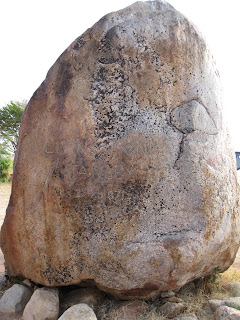
We all splashed about, enjoying the warm water and fresh air. After getting our fill of the heat, sand, and occasional ogling by the Burundian staff (the whistles were NOT welcomed), we packed everything up and headed back to Bujumbura. On the way, we pulled over onto a tiny, unmarked dirt road which led to one of Burundi’s few tourist attractions: the rock where Henry Morton Stanley, journalist-turned-explorer and operative of King Leopold II, allegedly “found” Dr. David Livingstone, who had been traipsing about East Africa in search of the source of the Nile River—and famously said, “Dr. Livingstone, I presume?”


To be fair, this may or may not have actually happened at this site. We know it happened near Lake Tanganyika, and the rock that marks the famous meeting overlooks the lake. Most people say the meeting actually happened in Ujiji, Tanzania. Apparently, Stanley and Livingstone traveled together for a while after their meeting, leaving markers of where they had been, and this might be just one of those markers. The large stone is engraved with their names, like strange historical graffiti. Burundi doesn’t have much in the way of landmarks, so I hope and wish for the sake of the tourism industry that this was the real meeting spot.

Nothing much is around the site (it’s really just a vista over the lake), but as we were wandering about and taking photos, children began to run up from the nearby huts to welcome us. We gave them leftover fruit from our picnic, played with them a bit, and then packed up to head back to Bujumbura before the curfew set in.

Wednesday, August 26, 2009

Anything Goes

So I finally got my visa. It took literally over a month to get a one-month renewal for my visa, and I think that only happened because our logistician seems to know everyone in Bujumbura. After losing my file for several weeks, it was found and I was issued a 70-day visa instead of a 30-day visa, which costs more than twice what I should have had to pay. Then, they demanded payment.

As a volunteer here for the past three months, I was pretty annoyed that the grand total for the visas alone was going to be $220. In the end, after having tried repeatedly to make an appointment with the always-absent top official at the PAFE (Police of the Air, Borders, and Foreigners) Office, we finally got in to see him. I tried to be as charming as possible without looking like a pushover, and used as much Kirundi as I could. Naturally, he asked me if I had a boyfriend, and where he was. In Kirundi. This was, luckily, among the questions that I know how to answer, because people ask all the time. (It’s a bit tiresome.) I also answered because I knew that he, and he alone, stood between me and the visa I wanted…and it was better than slipping him a $20 under the table.

After rustling through some papers, examining my file closely, making an exaggerated point of studying the calendar, and then my studying my file again, he said something in Kirundi to the logistician, who nodded and led me out. I asked him what happened.

“He’s giving you a 45-day visa for $90,” he said. Interesting. I’ve never heard of a 45-day visa, nor is it posted anywhere. It looks like something created for me because I created such a fuss, and for so long. It seems like rules here are flexible…in other words, anything goes.

Sadly, it appears that the visa delay issue (among many other visa dilemmas) is significant here. I was describing my situation to a friend who works for BINUB, the United Nations civilian mission in Burundi, and he explained that the PAFE “loses” muzungu visa applications on purpose. I didn’t believe him until I remembered that they had lost my boss’s visa application as well. At the PAFE, they drag their feet deliberately, until someone gives them the motivation to do something—that is to say, until someone gives them a bribe. Then…ta da! You have a visa, as if by magic. My friend said that it’s gotten so bad that he doesn’t work with them anymore—he works through higher officials to get UN visas processed.

The idea that corruption is rampant here is something to which I have not grown accustomed. My boss was pulled over by a policeman for talking on her phone while driving. After insisting that he see her identification, the policeman asked her to pay 5,000 Francs. She said that she would be happy to, if she received a receipt. The policeman shuffled his feet and looked down. “A receipt?” he repeated, as if he had never heard the word before. “Yes,” she said. “If you are pulling me over and are giving me an official ticket, then I want a receipt for the amount paid.”

The policeman looked uncomfortable. “It’s not a lot,” he insisted. My boss stood her ground. In the end, he returned her identification to her, and we drove off without paying any money.

That’s just a small example. For a big example, take malaria treatment. One of the best medicines you can get in this region for malaria treatment is called Coartem. It used to be available in Burundi, but an Indian company struck an under-the-table deal with people in the Ministry of Health, and now only their Indian-made malaria treatment drugs may be sold in the country. Coartem is no longer sold. If you want it, you’d better hope that a friend in Rwanda will send you some. In the meantime, the malaria treatment medication that is sold here is of questionable quality and may be expired. Great. A little extra mosquito repellent, please.

Then, you have the downright silly. The same friend from BINUB who told me how terrible the PAFE was recounted something that happened to him a couple of weeks ago. He and some friends ordered a container full of household goods, food, etc. Just to be clear about what I mean when I say container, it’s one of those massive metal boxes that 18-wheel tractor trailers transport. In other words, it’s big and heavy and hard to miss.

Well, his container arrived…and then disappeared into thin air. Since he’s at the UN, he knows the Burundian intelligence services, and called them up, asking them to conduct an investigation. Three days later, they found his container (much to his relief, as the container itself cost $1500), but it was completely empty. I find this absurd because we’re not talking petty theft, such as stealing a bag or wallet. To move a container, you need a crane and a tractor trailer. This was an operation.

I told an American friend who works in security about this, and he laughed. “Well, intelligence must have been in on it,” he insisted. “Containers don’t just vanish without someone noticing. And it took them three days? In a country this size? Are you kidding? That was just enough time for them to cover their tracks.”

It’s sad, of course. Signs around town proclaim that “Corruption enriches few people, and kills many,” but they probably have as much impact as the female condom advertisement, which just looks like a woman handing a plastic bag to a perplexed man. That is to say, these signs probably have little to no effect. In this environment of corruption and impunity, it feels like anything is possible, but not in the good way. Rules are simply guidelines; they are not strictly followed. It means that there is always room for negotiation here, for better or for worse. Right now, since I finally received my questionable visa, it’s for the better. In general, though, it’s certainly not the best.

Tuesday, August 25, 2009

A Small (But Charming) Welcoming Committee

Couldn't resist sharing this photo from my recent visit to the rock on the hill overlooking Lake Tanganyika where Stanley and Livingstone met (and Stanley reportedly uttered the famous words, "Livingstone, I presume?"). These charming kids ran up to meet me and my friends, and they danced and played with us. Full post forthcoming!

Wednesday, August 19, 2009

Taking the Good with the Bad

Every experience has its ups and downs, and I have compiled a list of some of the best—and worst—things I have experienced while I have been in Burundi. Here goes:

The Good

The beach. It really is paradise. (Just watch out for the crocodiles and hippos.)

Lake Tanganyika. I never imagined the water could be so aquamarine, and that a shoreline could be so picturesque. It’s like being in the Caribbean, in the middle of Africa.

People here are active. It’s amazing to see the groups and individuals of all ages running down the streets, doing push-ups by the side of the road, and playing soccer at all hours of the day. I have never seen anything like it anywhere else.

The monkeys. I love that they surprise you here. They are at work, at home, everywhere. It’s amazing how comfortably they live among people.

The Baguette Magique, the go-to bakery in town. Everyone loves this bakery, and while their cookies all taste the same to me (and leave a greasy residue on my hard palate), I love that the name, in English, is The Magic Stick. Like the 50 Cent song. And I can’t get it out of my head whenever I see their products.

My Burundian supervisor. Full of life and energy, he is a go-getter that actively disregards the red tape and bureaucracy that too often hamper progress. You have a problem? Go straight to him, and he’ll make a phone call to fix it. None of these month-long processes requiring formal letters with stamps and flourished signatures. If only more people were like him!

The Burundian drummers. My office is not far from the stadium, and every day around 4 pm, I hear the rhythmic beats of the drummers as they practice their craft.

Peas and lenga-lenga. This is my lunch every day, and I usually eat it with white rice. The peas here are excellent—really well seasoned—and seem to be more omnipresent than beans. Lenga lenga, a spinach-like vegetable, is also really good, and much better tasting than isombe, which is made of cassava leaves. (No one has been able to tell me what lenga lenga really is, though.)

The t-shirts. Really deserves its own section, because I’ve seen so many good ones. This is where shirts go to die, which is why I saw a guy wearing a shirt from my own hometown the other day. Other good ones:

Nothing Runs Like a Deere (Worn by a man running by the road)

Just because I’m up doesn’t mean I’m awake (Worn by an old woman at 7 am)

Big Johnson’s Weed Whackers (Illustrated with a flesh-colored appendage wearing a hat. Interpret at will)

And my personal favorite:
Worn by an elderly farmer on the side of the road to Makamba: Cheerleading is Life. The Rest is Just Details.


The Bad

The Immigration Office, which, after losing my file for a couple of weeks, continues to refuse to give me the visa I asked for, insisting I pay for one that is more than twice as expensive. They have now had my passport for a month.

The dust of the dry season, which has aged my laptop considerably…my advice: don’t bring a Dell or Mac—bring an IBM Thinkpad! Those computers are like tanks.

The mosquitoes. While not worse than other places I have been, every third person I know seems to contract malaria, making me think that the malarial rate here is quite high.

The traffic…and the accidents. New traffic lights were installed at one of the city’s worst intersections, but a car plowed into one of them, and now none of them work. The irony is overwhelming.

Isombe (cassava leaves). Never was a huge fan, but it makes the list of bad things because 1) it tends to be bitter, and 2) without fail, I always find a pebble in my isombe. I have no idea whether to attribute this to lack of cleanliness, or the mode of preparation, or what, but my teeth can’t handle it anymore.

The phone network. Maybe your friend will get your text message, maybe not…or maybe in three days. And when the network is down, an annoyed Burundian woman reprimands you for trying, because your call obviously cannot be completed, you jerk.

The ants. Even though their brains are Lilliputian, they seem to always outsmart—and outnumber—me. As soon as I put down my plate, they swarm it and try to carry it away. Now, after realizing that they live INSIDE the table where I prepare my food, I have been left with the dilemma of spraying them with poison--and in doing so, poisoning myself. As a result, I’ve resorted to pouring boiling water on the counter to wipe them out, or wiping down the counter with a thin layer of Rwandan pili-pili oil. In addition to adding a tasty flavor to my food, it repels pests! How versatile.

Sunday, August 16, 2009

A Simian Visitor

Saturday, I was still recovering from a light cold and severe migraine that had troubled me on Friday. I woke up at 8 and started working on my computer—it will be a miracle if my task here is complete before I leave—and took a break at noon to go for a run. Exhausted, I returned to my house, showered, and took a nap on the couch in the screen room. The cat at the house I am housesitting joined me, lazily outstretching herself and clawing at the cushions.

Something caught her attention, and I worried that she had seen the baby gecko that I had spotted the day before. She tends to massacre geckos, and I tend to protect them, since anything that eats mosquitoes is a friend of mine. She remained perked, jerking her head every now and then, but I couldn’t figure out what she was looking at.

I stretched and roused myself from my nap, and through the screen saw a lone monkey sitting on a branch of a tree in the garden, eating something orange. I looked at it for a while, puzzled that it was alone—monkeys travel in packs here—and when my curiosity was satisfied, I walked into the house.

The cat followed, but then froze. Standing in my dining room was a two-and-a-half foot tall monkey. He looked around, obviously confused, and then walked toward the cat, whose back was fully arched, and who immediately dashed out of sight, sliding on the floor as she went. On all fours, the brown monkey slowly meandered to the door through which I had come, looked around, and then turned around and walked back through the living room and into the dining room. He saw me, but seemed not to mind that I was there. It was more like a tacit acknowledgment.

As interesting—and humanlike—as this animal was, I was no fool. I wasn’t about to try to touch it, lest I catch Ebola or, God forbid, it attacks out of self-defense. Instead, I looked around my dining room to see what shiny objects it might take. My camera, my cell phone, and my laptop were all in plain sight. I moved slowly toward them, and the monkey turned and made its way into the kitchen. The kitchen door had been ajar, so this must have been how he had come in. He stood up on his hind legs and surveyed the scene, displaying how tall he was. Then he squeezed himself back through the door and rejoined his group, which by this point was jumping on the roof, pulling mangoes off the adjacent trees, and generally making a racket.

The guard was standing in the yard. “Did you see the monkey?” I asked. “He was in the house.”

He nodded, flabbergasted. “Ah, these monkeys, they just cause trouble!” the guard mustered. After I returned to the kitchen, he stood, staring openmouthed, at the roof.

Now, I have to go find that cat. The unexpected visit certainly redefines the idea of a house pest…or perhaps that of a house guest?

Tuesday, August 11, 2009

Local Eats

Steamed goat meat. Doesn’t sound like the most appealing dish in the world, but it is Burundi’s specialty. They call it muchopo, and the best versions of it can be found in the Asian Quarter and in Bwiza, the Congolese/Senegalese Quarter of Bujumbura.

As a thank you for taking me to the tailor on the weekend to check on my dress order, I told my Burundian co-worker that I would treat him to muchopo—but he had to pick the place. I had wanted to experience Bwiza, which is widely considered to be the liveliest neighborhood in town, but he insisted on the Asian Quarter (“There are too many fights in Bwiza,” he said).

We ambled into the neighborhood, rolling over potholes and unpaved roads. This area looks vastly different from the rest of the city. There are compounds, square buildings, small empty porches that become bars at some point in the evening. Men loitered here and there, and minarets of green and white rose over the rooftops. There are many Muslims in this area.

It’s called the Asian Quarter because of the businessmen. There is a significant population of Indians here, and I’ve seen a few Arabs as well. Since it’s near the port, they set up shop here, with little warehouses and distribution centers. My friend tells me it’s possible to find whatever you need in this area—he walked into a crowded little shop and asked if they had Tahini sauce; after digging around a bit and brushing off a layer of dust, a jar of sauce was produced.

We pulled into a courtyard with straw huts and tables. The place was called Chez Terrence, and was well known for its muchopo. After greeting literally everyone in the cabaret (my coworker seems to know everyone), we sat down at a little wooden table and ordered some muchopo and Amstel.

While we were waiting, a huge SUV rolled into the parking lot. Music was blaring from the open windows, and everyone was looking at the people who had just arrived. They jumped down from the car, laughing and talking much louder than necessary. The men wore camouflage shorts and flip flops and the women were prancing about in strapless tops. They popped open the back, where they sat and tailgated, drinking massive beers and being obnoxious.

“Rwandans,” my coworker sighed. I nearly passed out laughing. In any other country, people would have thought they were American. Camouflage shorts? I have never seen a Rwandan man wearing shorts. Only schoolboys wear shorts. But apparently Rwandan men wear them when they come here. It was only too funny to see from this other perspective.

The muchopo emerged, on a wide plate, covered with thinly sliced and somewhat pickled onions, and served with a side of umurobe, which is a cassava-based starchy dough. It’s more dense than ugali, and I have been told that it keeps for a month on the counter (this is very questionable). Eating umurobe is like eating a brick—it just sits in your stomach, feeling heavy and unhealthy and with little nutritive value. I expected the steamed meat to be gray and soggy, but for some reason, its exterior was crispy and the interior was as tender as goat meat can be. It was chopped in finger-food sized pieces, and you had to pay attention as you were eating, as some of them still had a couple of goat hairs attached. Some of the chunks I picked up were stained dark blue, which makes me think they used blue twine in the cooking process…so I didn’t eat those bits, but beyond that, it was surprisingly delicious. Apparently it takes seven hours for muchopo to cook (when steaming meat like that, it doesn’t surprise me that it takes so long).

My coworker insisted that we also try their goat brochettes, since I still hadn’t had a particularly good one here in Burundi. He ordered me one, despite the fact that I was full of umurobe. As we sat in the dark, chatting with some of his friends that joined us at our table, I took several bites. The brochettes were…surprising. The first bite was tough. The second was too soft and tasted a bit weird—that turned out to be goat liver, and I couldn’t manage to spit it out without looking crass, so I just chewed it as much as I needed to before swallowing it in a big chunk. Blech. The next morsel was a huge chunk of fat, which was as soft as the liver, but was so chewy that I realized what I was eating and held it solemnly in my mouth until everyone turned to the server to order more beer. I then managed to throw it over my shoulder, and no one was the wiser.

The verdict: Burundi muchopo good, Burundi brochettes…not so much.